For accelerators, incubators and startup competitions
Read every application the way an investor would. Then pick your cohort.
Drop in a batch of decks or forward the application e-mails. Each deck is read the same way and checked against your own selection criteria, so the committee compares the businesses behind the slides, not the teams that write the best decks.
Up to 40 decks per batch · your rubric, your decision · reports in Polish or English · hosted in the EU
From applications to a cohort
Selection is where a programme wins or loses. That is where pitchera starts.
Collect: no forms to rebuild
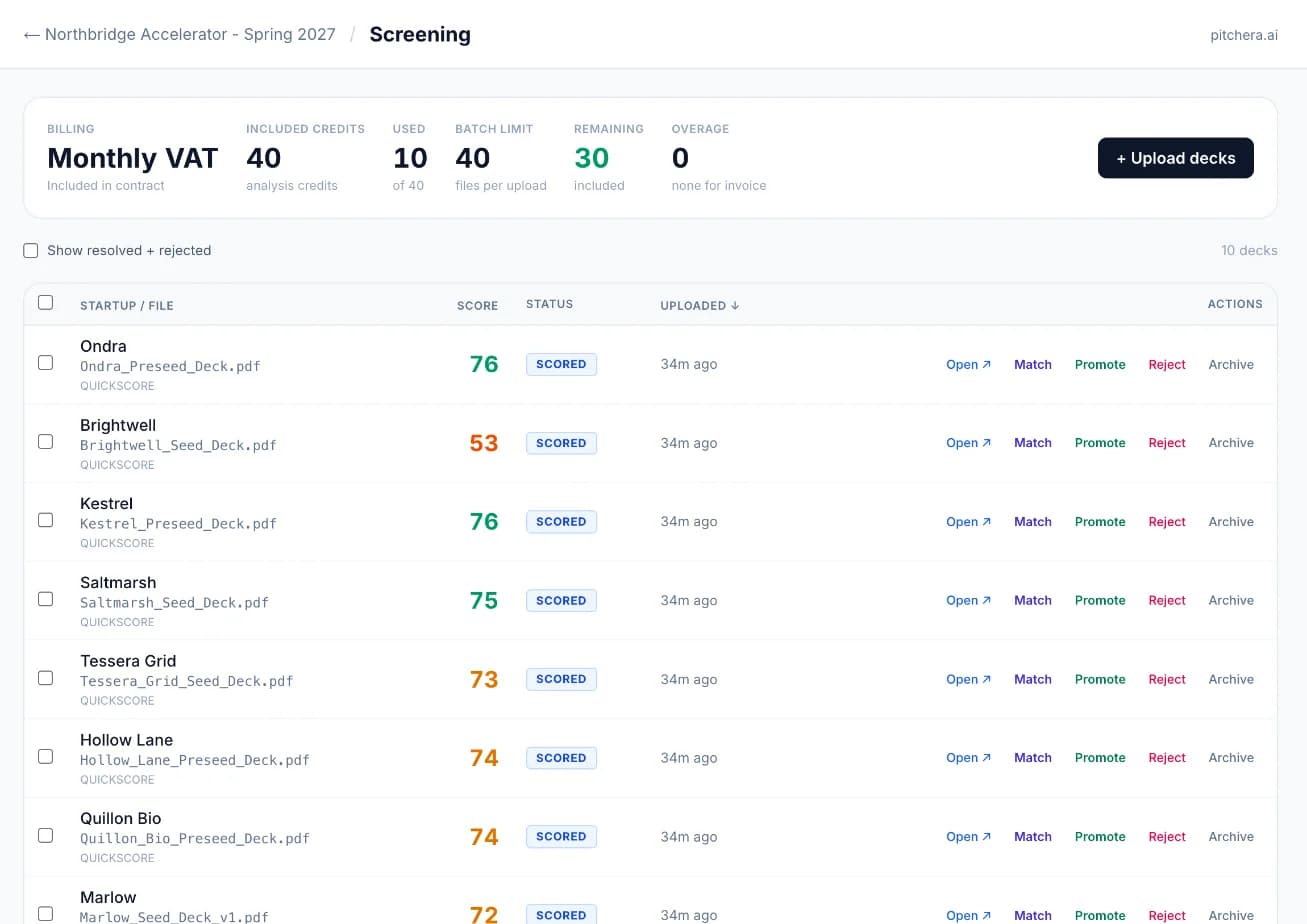
Upload a batch of up to 40 PDF decks at once, or give applicants your programme's screening address and forward what lands in your inbox. Every deck is analysed and lands in one sortable table.
Select: your criteria, the same reading for all
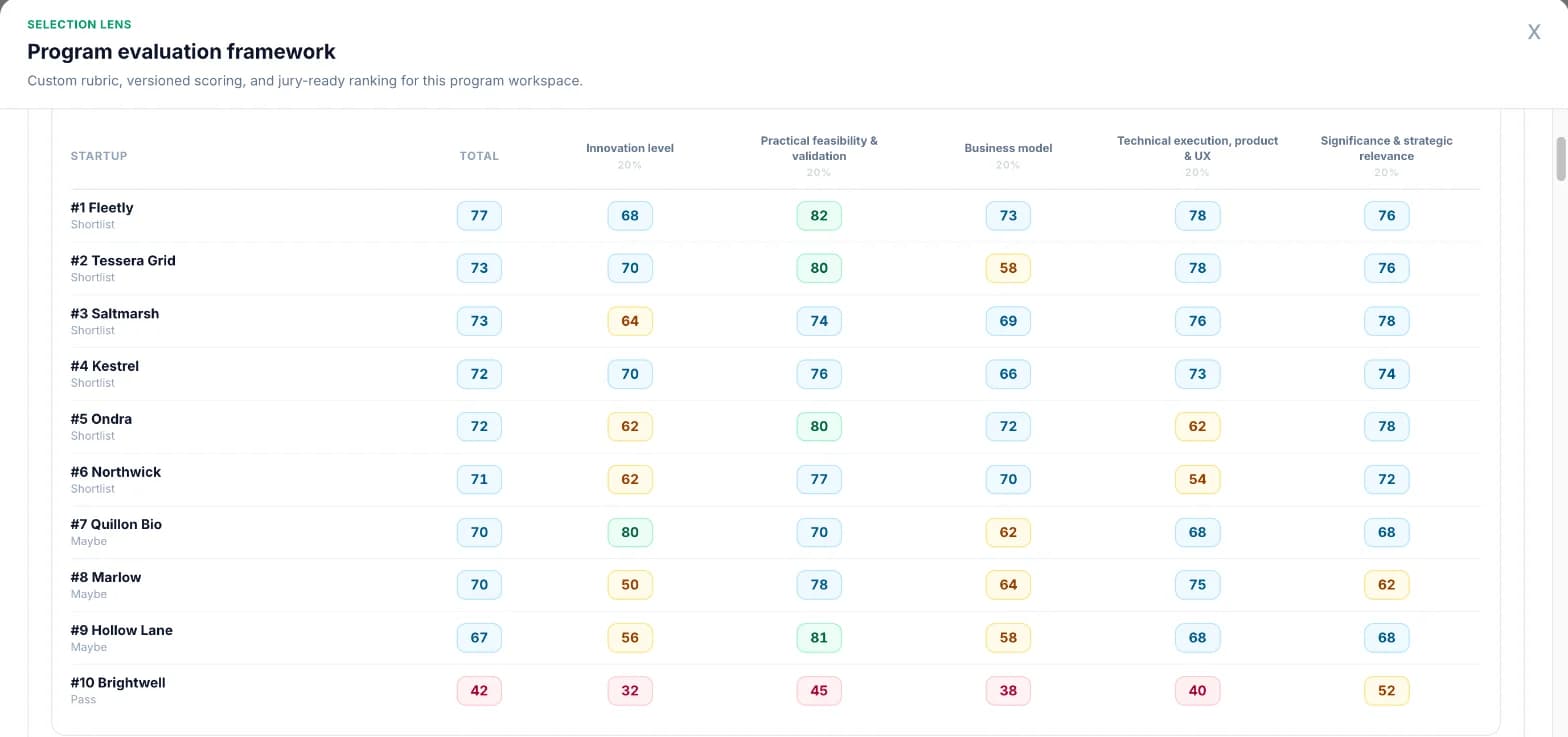
Set your rubric - innovation, feasibility, business model, team, impact, or your own. Each application is checked against it, decks can be compared side by side, and the committee gets a selection memo and a jury report PDF with your logo.
Admit and follow: before and after
Promote the teams you pick and invite them in Polish or English. Founders complete a business briefing at the start and again at the end; you see the change per team, with a short written summary of what moved.
For the committee
A jury pack, not a pile of PDFs
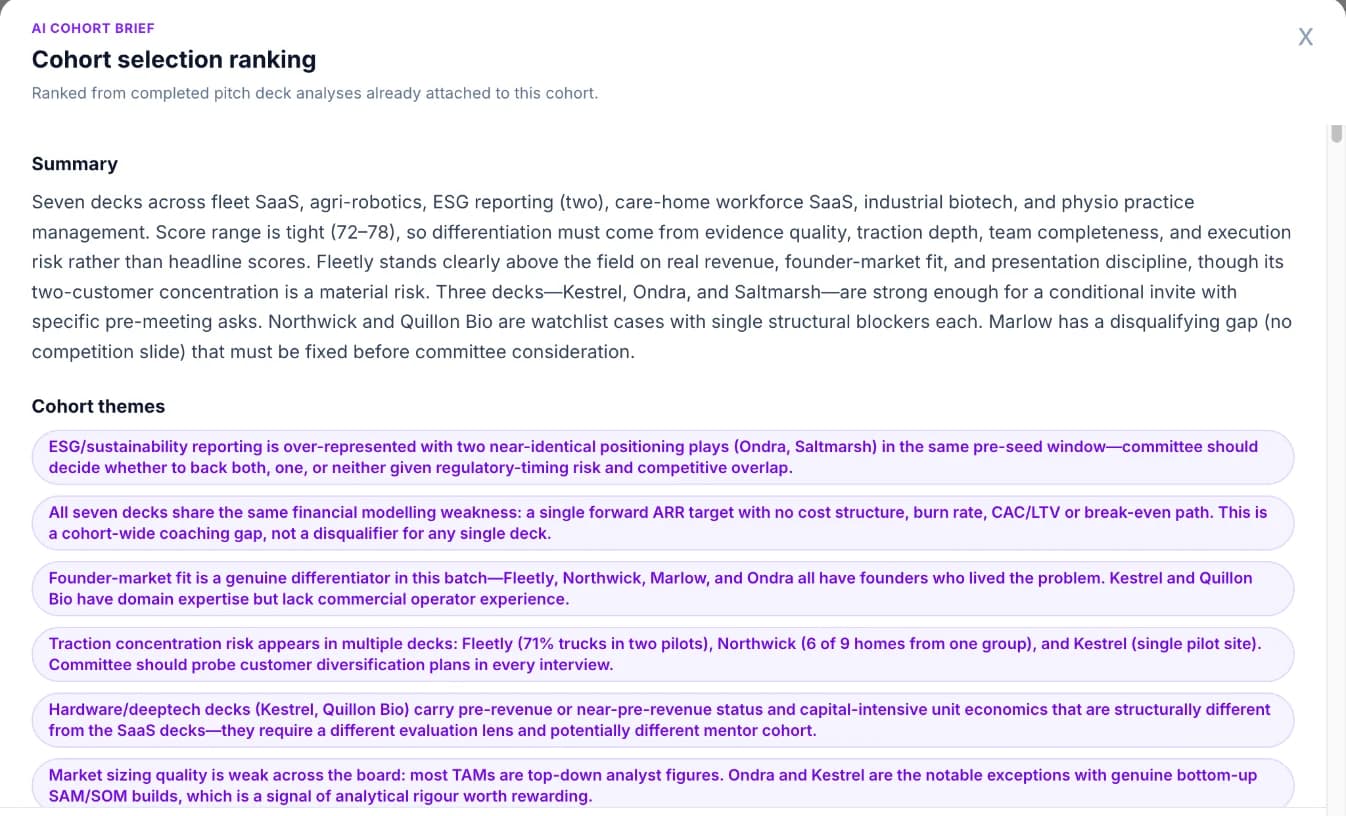
Every application scored against your rubric, compared side by side when two teams are close, a written selection memo, and a jury report PDF with your programme's logo. Then promote the teams you pick to the cohort in one step.
What founders get
Their own report, never anyone else's
Admitted founders get their report in Polish or English, by e-mail and as a PDF with your programme's logo next to ours. Applicants see nothing from screening; those analyses belong to your programme.
Before and after, per team
What the programme changed, in writing.
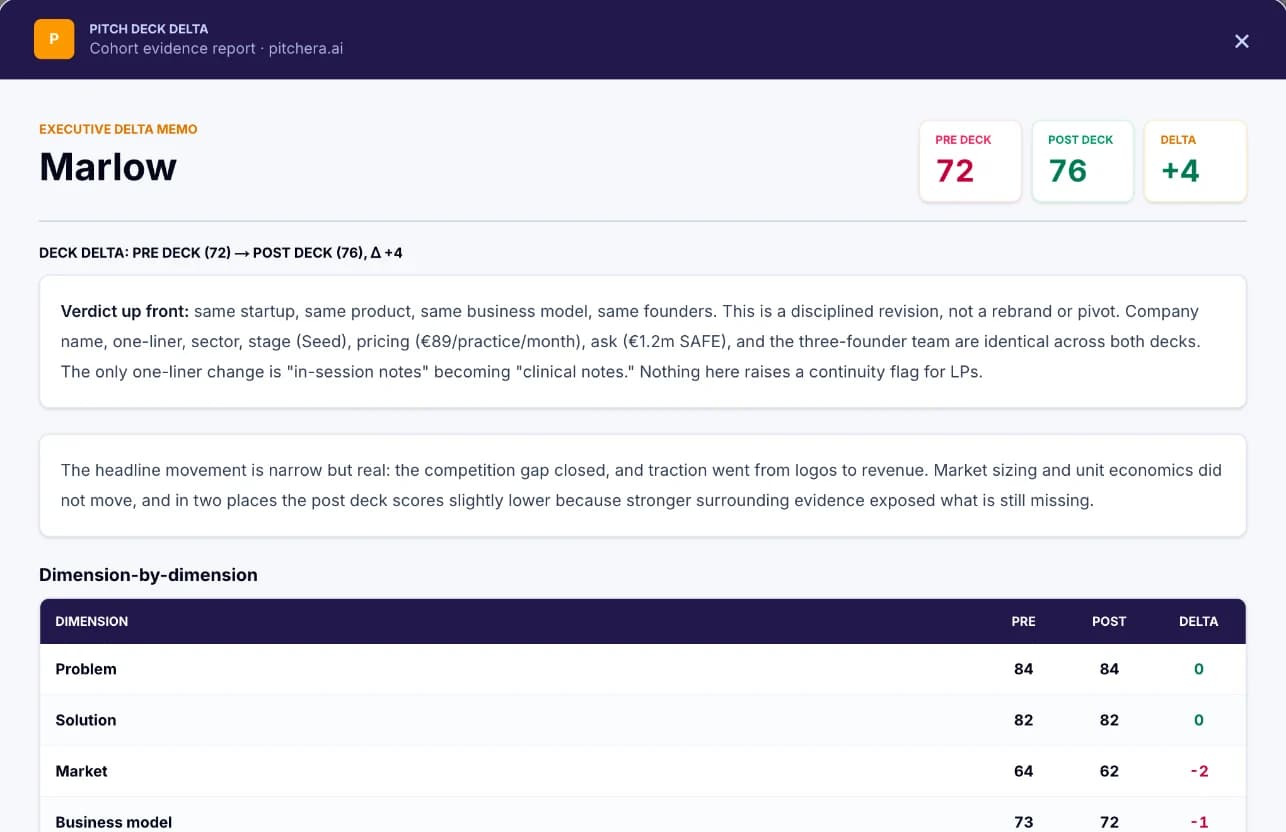
Each founder fills in the same business briefing at intake and at the end, and you see where every team moved with a short written summary. When a team sends its demo day deck, match it to the one it applied with: the report says whether it is the same business, what improved and what is still missing.
See a sample cohort dashboard with before and after for twenty fictional teams.
Who sees what
The programme team sees everything. Founders see only themselves.
- Programme team - the Screening Room, the cohort dashboard and every report, through a private admin link.
- Organisations with several programmes - all of them in one place, with usage per programme.
- Founders - their own report and briefing, nothing about other teams.
- Mentors - assigned to teams on the dashboard, so the programme team knows who works with whom.
Not built yet, shaped with the first programmes
We would rather say what is not ready than sell it. These come next:
- A mentor's own view and a session log
- A one-page cohort report for sponsors and boards
- CSV and assessment exports for university courses
- Your cohort in Claude or ChatGPT, as investors already have it
Pricing
Per selection round, or per year for programmes that run all the time.
One round is one price: up to 40 applications screened, your rubric, the selection memo and jury report, invitations and the before / after briefing for the teams you admit. Several rounds, programmes or a network of incubators get an annual plan, invoiced monthly.
Selection round
from $1,490
- Up to 40 applications analysed
- Batch upload and e-mail intake
- Your rubric, side-by-side comparison
- Selection memo and jury report PDF with your logo
- Invitations and before / after briefing for admitted teams
Programme, annual
quoted
- Everything in a round, for every round that year
- Several programmes under one organisation
- Analyses beyond the bundle on the same invoice
- Monthly invoice, data processing agreement
- First say in what we build next
Questions programmes ask us
Does pitchera choose the cohort for us?
No. It reads every application the same way and checks it against your criteria; the shortlist, maybe and pass column is a suggestion. Your committee meets the founders and decides.
How do applications get in?
Two ways: upload PDF decks in batches of up to 40, or switch on your programme's screening address and forward application e-mails with the deck attached. Keep your own application form if you have one; only the deck needs to reach us.
What do applicants see?
Nothing from screening - those analyses belong to your programme. Teams you admit get an invitation and, from then on, their own reports. Nobody sees another team's material.
How does before and after work?
Admitted founders fill in the same business briefing, about 35 minutes, at the start and at the end of the programme. You see where each team moved, with a short written summary, and the average change for the cohort. A team's new deck can also be matched to the one it applied with.
Which languages?
Polish and English. A Polish deck gets a Polish report and an English deck an English one; invitations go out in the language you choose.
We also need mentor tracking, sponsor reports or exports. Can we have them?
Not out of the box yet. Mentor assignment to teams is there; a mentor's own view, a one-page report for sponsors and course exports are next, and the programmes that ask first shape them. Tell us what your board or university needs to see.
Where is the data, and who owns it?
Hosted in the EU (Frankfurt), encrypted at rest, with encrypted off-site backups in the EU. Founders own their reports; the screening analyses are your programme's. GDPR applies and a data processing agreement is available on request.
Book a demo
Fifteen minutes, ten applications from your last round.
Send us ten decks from a past selection. We screen them against your criteria live, show you the memo and one founder report, and you judge whether it would have changed who got in.
Prefer e-mail? [email protected]